Party wall notice template
- Notices to serve in this job
- 4
- Computed on this page from the inputs below
- Days left to serve a party structure notice
- 26
- Computed on this page from the inputs below
- Days left to serve an adjacent excavation notice
- 57
- Computed on this page from the inputs below
- Days left to serve a line of junction notice
- 57
- Computed on this page from the inputs below
Every answer on this site comes out of the figures you type and the method printed beside them: your start date, your adjoining owners, your rooms and elevations, your surveyor's hourly rate. Where a period comes from the Act rather than from you, the section is linked so you can read it. Statutory periods are counted at their longest, two calendar months as 62 days and one as 31, so a date this site gives you is never short of what the Act asks.
Email me this result
We will send you these figures and a link back to them. One email, nothing else unless you tick the box.
The figures above start from a worked example (4). Change any input and the answer updates as you type, the way it will on the address record.
Download the Party wall notice template worked example (CSV)
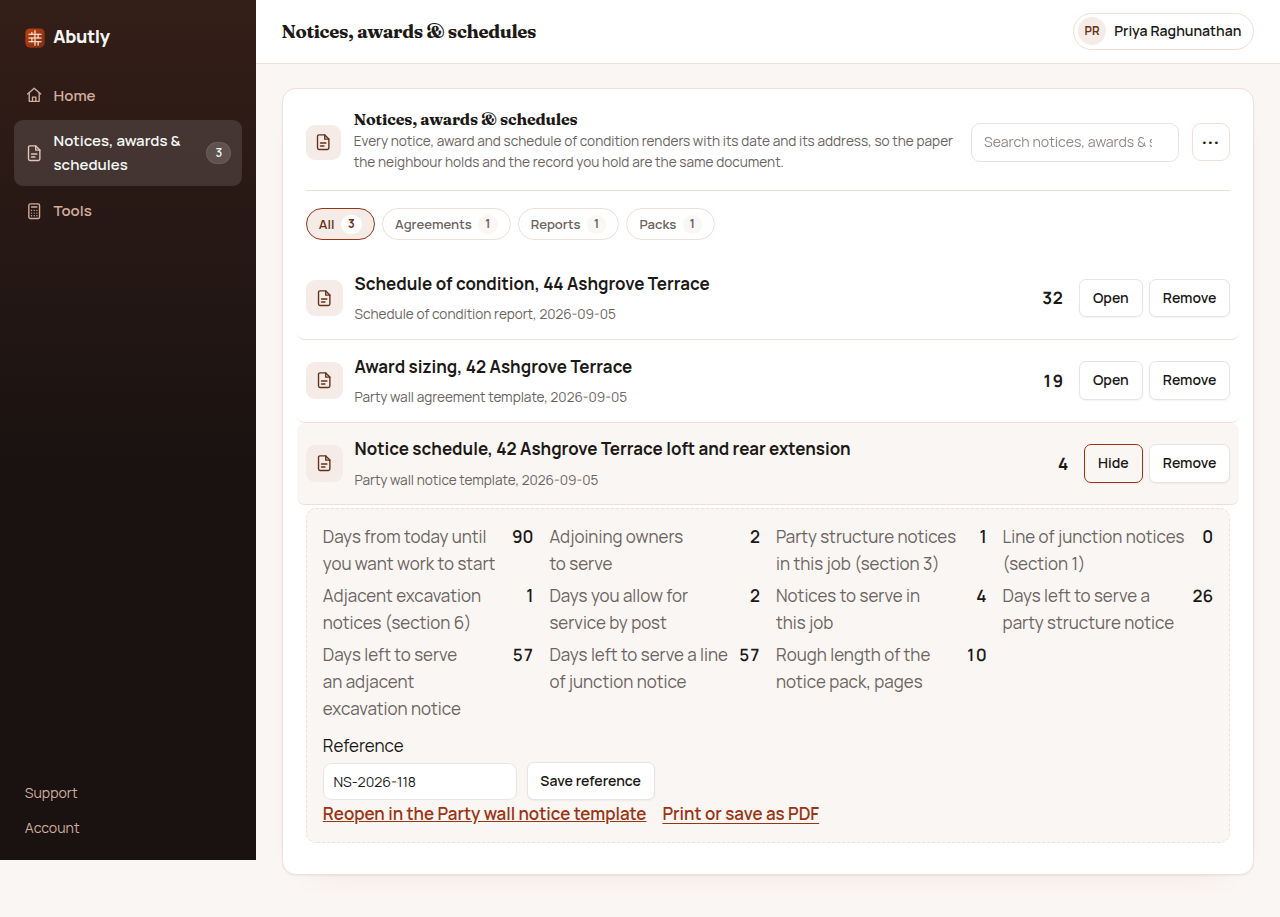
This worksheet counts the party wall notices a job needs and the days you have left to serve each one. Enter how far away your start date is, how many adjoining owners there are, and how many of each kind of notice the work calls for, and it gives you the total number of notices to write, the days left to serve a party structure notice, an adjacent excavation notice and a line of junction notice, and the rough length of the pack. Statutory periods are counted at their longest, two calendar months as 62 days and one month as 31, so the date it gives you is never short of what the Act asks.
What a building owner asks before running the Party wall notice template
Why does it count two months as 62 days? Because two calendar months is between 59 and 62 days depending on where in the year it falls, and a notice that is a day short is not a valid notice. Counting at the longest means the date this worksheet gives you works in July as well as in February.
Why is the answer per owner rather than per house? Because the Act serves owners, not buildings. A house next door with one freeholder is one adjoining owner; a converted house with a leaseholder above, a leaseholder below and a freeholder is three, and each of them gets their own notice of each kind.
What if the number of days left comes out negative? Then the start date is inside the notice period and something has to move: the start date, or the job. A negative answer here is the useful one, because it is far cheaper to find out now than after the builder has booked the scaffolding.
Where the constants in this tool come from
Party Wall etc. Act 1996, section 3: party structure notices.
Party Wall etc. Act 1996, section 1: new building on line of junction.
Party Wall etc. Act 1996, section 6: adjacent excavation and construction.