Schedule of condition report
- Items the schedule will hold
- 32
- Computed on this page from the inputs below
- Photographs to take
- 64
- Computed on this page from the inputs below
- Time on site, minutes
- 126
- Computed on this page from the inputs below
- Rough length of the report, pages
- 17
- Computed on this page from the inputs below
Every answer on this site comes out of the figures you type and the method printed beside them: your start date, your adjoining owners, your rooms and elevations, your surveyor's hourly rate. Where a period comes from the Act rather than from you, the section is linked so you can read it. Statutory periods are counted at their longest, two calendar months as 62 days and one as 31, so a date this site gives you is never short of what the Act asks.
Email me this result
We will send you these figures and a link back to them. One email, nothing else unless you tick the box.
The figures above start from a worked example (32). Change any input and the answer updates as you type, the way it will on the address record.
Download the Schedule of condition report worked example (CSV)
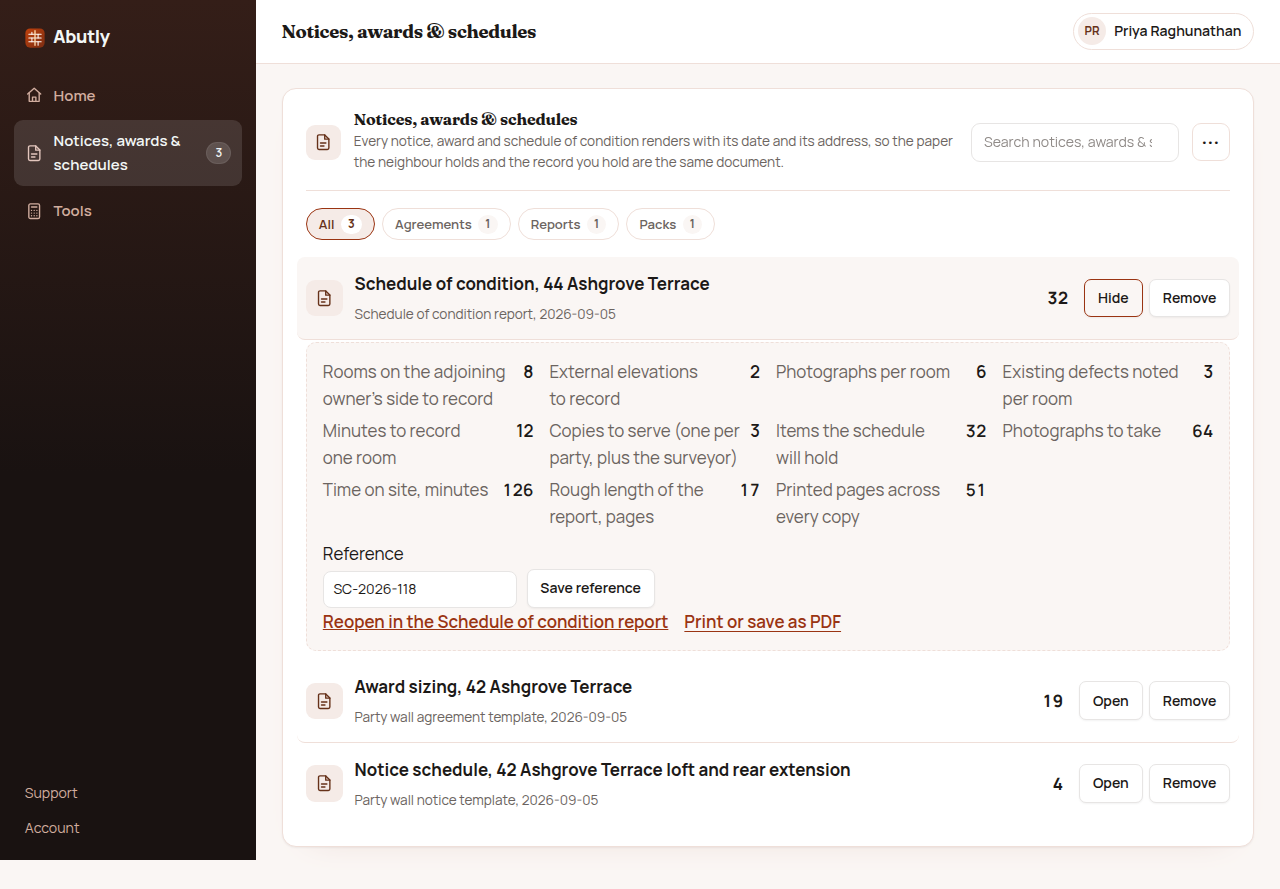
This worksheet sizes a schedule of condition, the photographic record of the adjoining owner's property taken before the work starts. Enter the rooms and external elevations you will record, the photographs and existing defects per room and how long a room takes, and it gives you the items the schedule will hold, the photographs to take, the time on site in minutes, a rough length in pages and the printed pages across every copy you have to serve. A schedule that misses a room is worth very little later, so the point of counting first is to book enough time.
What a building owner asks before running the Schedule of condition report
Which rooms should go in? Every room on the adjoining owner's side that could plausibly be affected, plus the elevations facing the work. Surveyors differ on how far to go, but the room you leave out is the room the crack appears in, and adding one takes minutes on site and nothing at all afterwards.
Why does it count printed pages? Because the schedule is served, and every party gets a copy. A schedule that runs to seventeen pages becomes fifty-one across three copies, which is the difference between printing it in the office and sending it out.
Does a schedule of condition stop a dispute? No, but it decides one. Without it, an argument about whether a crack was there before the work is two memories against each other; with it, it is a dated photograph. That is why it is attached to almost every award.
Where the constants in this tool come from
Party Wall etc. Act 1996, section 10: resolution of disputes.